

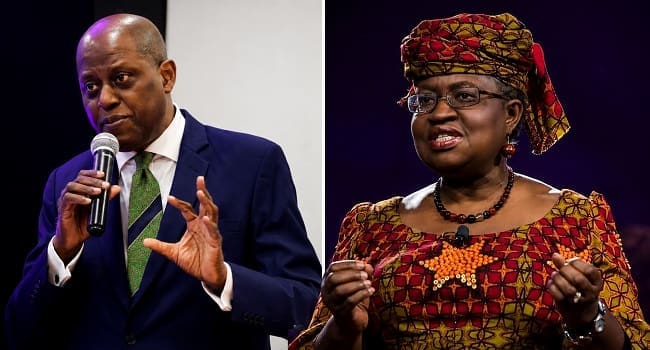
The Director-General of the World Trade Organisation, Dr Ngozi Okonjo-Iweala, and the Central Bank of Nigeria Governor, Olayemi Cardoso, have said Africa cannot simply wait for the old world order to return. It has to build the institutions, the trade links and the domestic capital base to compete inside the new one.
The two headlined the 7th Africa Emerging Markets Forum, held under the theme “Building Resilience Amidst Geoeconomic Uncertainties” and jointly organised by the CBN, the Emerging Markets Forum (EMF) and the Centre for the Study of the Economies of Africa (CSEA).
Their fireside dialogue on Wednesday drew policymakers, central bankers, ministers, development partners and economists from across Africa and beyond, alongside World Bank Chief Economist Indermit Gill, EMF founder Harinder Kohli, and Ahmadu Bello University Vice-Chancellor Professor Adamu Ahmed.
Three forces reshaping the map
Cardoso used his address to lay out what he called three structural shifts now rewriting the rules for economies like Nigeria’s. Trade, he said, is fragmenting as countries reorganise supply chains around trusted partners through nearshoring and friend-shoring, a retreat from globalisation that carries a warning for Africa but also an opening, given that intra-African trade still accounts for only about 16 percent of the continent’s total commerce.
The African Continental Free Trade Area, he argued, gives the continent a platform to close that gap, but only if governments move past signing agreements and actually fix the transport corridors, harmonise customs regimes and speed up cross-border payments that currently make trading with a neighbour harder than trading with Europe or Asia.
The second shift is in capital. The era of cheap money chasing yield with little regard for risk is over, Cardoso said: “Investors now reward transparency, institutional strength and policy consistency, and increasingly bypass markets that cannot offer it.”
READ ALSO
- Cardoso, Okonjo-Iweala to Lead Abuja Forum on Economic Resilience
- Businesses Still Face Costly Credit Despite CBN’s Inflation Gains
- Tinubu Signs Virtual Assets Order, Sets Up CBN-led Council to Tighten Oversight
That, in his view, makes credibility a national economic asset rather than a narrow central-banking concern, and it means African countries must mobilise their own pension funds, insurance assets, domestic savings and diaspora wealth rather than leaning solely on foreign inflows.
The third is artificial intelligence, which Cardoso said is already changing how goods are produced and services delivered and which Africa risks experiencing only as a consumer unless it invests in electricity, connectivity and a generation of AI-literate young people capable of building solutions rather than importing them.
He pointed to Nigeria’s own experience, unifying the exchange rate, ending the central bank’s financing of government deficits, and rebuilding a transparent foreign exchange market as evidence that painful, consistent policy choices do eventually show results in moderating inflation and strengthening external buffers, even after an energy price shock.
Africa’s route to converting global disruption into gains, he said, rests on four pillars: macroeconomic stability, continental trade scale through AfCFTA, patient domestic capital, and investment in people, especially young Africans and women, without whose full participation, he said, “Africa cannot fly with one wing.”
Okonjo-Iweala: leadership, not resources, will decide outcomes.
Okonjo-Iweala’s intervention pressed a related but sharper point: Nigeria’s and Africa’s economic future will be determined less by the size of their resource endowment than by the quality of their leadership and governance.
She credited the CBN’s monetary and foreign exchange reforms as a genuine restoration of confidence but urged that the momentum be sustained through careful fiscal management and cautious debt contraction, with job creation kept as the ultimate test of whether reforms are working for ordinary citizens.
On trade, the WT DG said the continent holds an estimated 30 per cent of the world’s known mineral reserves, comparable to Latin America, but that will not by itself break the extract-and-export pattern that has driven decades of volatility.
She challenged African governments to lift intra-continental trade from roughly a fifth of total trade toward double that share within five to six years, describing AfCFTA as one of the continent’s most powerful available tools if governments choose to use it.
The two speakers converged on urgency without alarmism: both framed the current turbulence in global trade, capital flows and technology as a genuine opportunity for emerging markets to move from rule-takers to rule-shapers — but one that will not be handed to Africa passively.
It will require, as Cardoso put it, strategic collaboration, credible institutions and the will to act together.
The forum continues to feature ministerial keynotes from Finance and Coordinating Minister of the Economy Taiwo Oyedele and the Minister of Science, Technology and Innovation, alongside sessions on cross-border payments, fintech, infrastructure and technology transfer — the practical machinery, delegates were reminded, on which any resilience strategy ultimately depends.
Sunday Michael Ogwu is a Nigerian journalist and editor of Pinnacle Daily. He is known for his work in business and economic reporting. He has held editorial roles in prominent Nigerian media outlets, where he has focused on economic policy, financial markets, and developmental issues affecting Nigeria and Africa more broadly.