

By Esther Ososanya
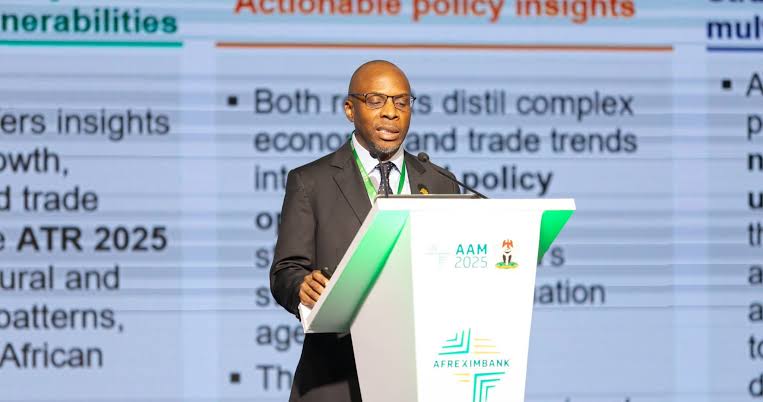
Africa is being held back by flawed external credit ratings that overlook its true economic realities, says Dr. Yemi Kale, Group Chief Economist at Afreximbank.
Speaking during the public presentation of the 2025–2026 Trade and Economic Outlook Report in Abuja at the AAM 2025, Dr. Kale warned that Africa’s cost of borrowing is being artificially inflated by credit rating agencies using frameworks that do not align with the economic, political, or financial contexts of African nations.
Kale said, “The argument is clear: we need an African-centered credit rating agency, one that understands the nuances of our economies and develops indicators that actually make sense for African realities.”
Global Ratings, Local Damage
Kale explained that Western credit rating models, designed with developed economies in mind, often penalize African countries unfairly. As a result, African governments and institutions are forced to borrow at prohibitively high interest rates even when their economic fundamentals are improving.
“Let’s say an African country is projected to grow by 2%, but a downgrade means investors now expect 5% to cover ‘perceived risk.’ That’s the cost of an unfair system,” Kale lamented.
This distortion, he said, discourages investment, increases debt service costs, and ultimately slows down development across the continent.
A Vicious Cycle
The report shows that many African countries continue to struggle with high sovereign debt levels, some of it due to these flawed credit metrics.
According to Kale, “The downgrade of a country doesn’t just hurt that government’s access to funds; it also makes it harder for banks to lend to local businesses, since borrowing costs increase across the board.”
Despite these limitations, he noted that Africa’s actual economic performance tells a different story.
The continent is expected to grow by at least 3.3% in 2025, with intra-African trade expanding and inflation gradually tapering off. “All indicators show improvement,” he added, “but rating systems don’t reflect that.”
Building an African Solution
To break the cycle, Kale strongly advocated for an African-owned and operated credit rating agency. While such a system would face resistance initially, he believes it could earn legitimacy with time, transparency, and adoption by African governments.
“The Asian countries already have theirs, we cannot keep using tools that misrepresent our strengths. If we don’t rate ourselves accurately, we will continue to pay for others’ perceptions.”
This is not the first time African leaders have called for an independent credit assessment framework. But Kale’s statement, coming from one of the continent’s top economists and backed by Afreximbank’s research, carries new weight amid mounting evidence of structural bias in global finance.
The Way Forward
Beyond rating reforms, the Afreximbank economist urged for the strengthening of African multilateral financial institutions. With international capital markets becoming more volatile and inaccessible, he said, African banks must step up as the “shock absorbers” for the continent.
“If we develop and capitalise our own banks, we don’t need to rely on eurobond markets with unrealistic premiums,” Kale added. “This is not just about pride; it’s about economic survival.”
What’s at Stake for Africa?
- Poor credit ratings increase interest rates on loans.
- African countries end up paying 2–3 times more than global peers to raise the same capital.
- A downgrade affects both sovereign and private borrowing costs.
- Bias in global ratings fuels capital flight and stifles growth.
Kale said, “If we don’t rate ourselves accurately, we will continue to pay for others’ perceptions.
“We are forced to pay higher for capital not because our fundamentals are bad, but because our realities are misunderstood.”

Esther Ososanya is an investigative journalist with Pinnacle Daily, reporting across health, business, environment, metro, Fct and crime. Known for her bold, empathetic storytelling, she uncovers hidden truths, challenges broken systems, and gives voice to overlooked Nigerians. Her work drives national conversations and demands accountability one powerful story at a time.