

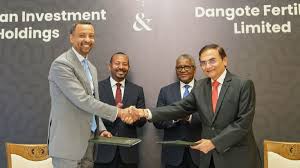
Ethiopian Investment Holdings (EIH), the government’s strategic investment arm, has partnered with Dangote Group to develop a state-of-the-art urea fertiliser production complex in Gode, Ethiopia.
The two companies have signed a comprehensive shareholders’ agreement to build one of the world’s largest single-site urea fertiliser production plants, marking a significant step in the industrialisation of Ethiopia’s agricultural sector.
Partnership Structure and Ownership
Under the terms of the agreement, EIH will hold a 40% stake in the project, while Dangote Group will maintain a 60% share.
The partnership aims to establish a world-class facility with an annual production capacity of up to three million metric tonnes of urea fertiliser, making it one of the top five largest fertiliser production complexes globally.
The facility’s development includes advanced infrastructure such as gas transport pipelines, storage facilities, and logistics for both domestic and regional markets. The estimated project development costs are set at $2.5 billion, with a projected completion time of 40 months.
Strategic Location and Gas Supply Infrastructure
A significant aspect of this investment is the construction of dedicated pipeline infrastructure to transport natural gas from Ethiopia’s Hilal and Calub gas reserves to the production facility in Gode.
The pipeline will ensure a reliable and cost-effective feedstock supply for the fertiliser complex, playing a crucial role in the plant’s long-term sustainability.
According to Aliko Dangote, President and CEO of Dangote Group, “This partnership with Ethiopian Investment Holdings represents a pivotal moment in our shared vision to industrialise Africa and achieve food security across the continent.
The strategic location of Gode, combined with Ethiopia’s abundant natural gas resources, makes this the ideal site for what will become one of the world’s largest fertiliser complexes.”
Supporting Ethiopia’s Agricultural Sector
The new fertiliser plant will play a critical role in enhancing Ethiopia’s agricultural productivity, a sector that employs over 70% of the country’s population.
With reliable access to high-quality fertilisers at competitive prices, the project is expected to boost crop yields, improve farmer incomes, and contribute to national food security goals.
By reducing Ethiopia’s dependence on fertiliser imports, the complex will help stabilise prices and supply, benefiting farmers across the country.
Dr Brook Taye, CEO of Ethiopian Investment Holdings, expressed confidence in the partnership, stating, “This agreement marks a significant milestone in Ethiopia’s journey toward industrial self-sufficiency and agricultural modernisation.
The project aligns perfectly with our national development priorities and will substantially enhance agricultural productivity while positioning Ethiopia as a regional hub for fertiliser production.”
Regional and Global Impact
With an annual capacity of three million metric tonnes, the Gode fertiliser complex will exceed the capacity of most existing global facilities.
Ethiopia will emerge as a key player in the global fertiliser market, strengthening its role as a major supplier for the African continent.
The project will also create employment opportunities, both directly and indirectly, while fostering broader regional integration.
Neighbouring countries could benefit from a reliable supply of fertilisers, reducing import costs and improving agricultural output across East Africa.
This partnership combines Dangote Group’s experience in large-scale industrial projects across Africa with Ethiopian Investment Holdings’ deep knowledge of the local market and regulatory landscape.
Together, they are set to transform Ethiopia’s fertiliser industry, boost food security, and drive sustainable economic growth.
Sunday Michael Ogwu is a Nigerian journalist and editor of Pinnacle Daily. He is known for his work in business and economic reporting. He has held editorial roles in prominent Nigerian media outlets, where he has focused on economic policy, financial markets, and developmental issues affecting Nigeria and Africa more broadly.
- Sunday Micheal OGWU
- Sunday Micheal OGWU
- Sunday Micheal OGWU
- Sunday Micheal OGWU